






|
Patrons | Board of Directors | Officers
Patrons:
Chief Patron

His Holiness the 14th Dalai
Lama of Tibet, Tenzin Gyatso
“…genuine
happiness consists in those spiritual qualities of love, compassion,
patience, tolerance and forgiveness and so on. For it is these which
provide both for our happiness and others’ happiness”
His Holiness the Dalai Lama is distinguished
as a leading proponent of human rights and world peace. As the head
of state and spiritual leader of the Tibetan people, his efforts
to end the suffering of the Tibetan people have earned him international
respect. In 1989, His Holiness accepted the Nobel Peace Prize on
the behalf of oppressed everywhere and all those who struggle for
freedom and work for world peace and the people of Tibet. In his
remarks he said, "The prize reaffirms our conviction that with
truth, courage and determination as our weapons, Tibet will be liberated.
Our struggle must remain nonviolent and free of hatred."
In 1981, His Holiness expressed his appreciation
of diversity at the World Congress of Faiths, "I always believe
that it is much better to have a variety of religions, a variety
of philosophies, rather than one single religion or philosophy.
This is necessary because of the different mental dispositions of
each human being. Each religion has certain unique ideas or techniques,
and learning about them can only enrich one's own faith."
His Holiness was born in 1935, in northeastern
Tibet. The Dalai Lamas are believed to be the manifestations of
the Bodhisattva (Buddha) of Compassion, who chose to reincarnate
to serve all beings.
When not traveling and teaching, he follows
the life of Buddhist monk, living in a small cottage in Dharamsala,
he rises before dawn to meditate, pursues an ongoing schedule of
administrative meetings, private audiences and religious teachings
and ceremonies.
Courtesy: http://www.tibet.com
Back
To Top
Patrons:

His Holiness Sakya Trizin
His Holiness Sakya Trizin, born in 1945 in the Sakya
Palace at Tsedong, is the head of the Sakya Lineage. His childhood
name was Ayu Vajra. In 1951 he formally received the title of Sakya
Trizin from the Dalai Lama - thus becoming the forty-first holder
of this position.
In 1964 His Holiness undertook the task
of re-establishing the main seat of the Sakya Order at Rajpur, near
Dehra Dun in the Indian state of Uttaranchal.
It was here that he founded The Sakya Centre for the training of
young monks in ritual. In 1972, Sakya College was established at
Rajpur at the request of his Holiness. Through this particular initiative
he played a major part in the revitalization of traditions of Tibetan
Buddhism and in ensuring the supply of a new generation of well
trained teachers. Meanwhile larger permanent premises for Sakya
College have been built at Rajpur.
When not engaged on his many commitments,
His Holiness lives at the Dolma Phodrang in Rajpur, Northern India
together with his wife and two sons , this in the interests of preserving
unbroken the traditions of the Khön Lineage which has a long
history extending back to pre-Buddhist Tibet.
Courtesy: http://www.sakyatemple.org/
Back
To Top

His Holiness Chetsang Rinpoche the 37th Drikung Kyabgon
His Holiness Chetsang Rinpoche
the 37th Drikung Kyabgon is the head of the Drikung Kagyu order
of Tibetan Buddhism. He resides at JangChub Ling in Dehra Dun, Northern
India. In 1985 Drikung Kyabgon founded the Drikung Kagyu Institute,
an education center, which emphasizes both traditional monastic
education and contemporary training. The Institute has started a
research project collecting all the Drikung Kagyu texts and the
latest project is a Computer Library, where documentation materials
on the ways of living, philosophy and religious thought of the peoples
of the Himalayas are to be centrally registered. There is also a
meditation retreat center nearby.
His Holiness Chetsang Rinpoche was born
in 1947 in Lhasa. In 1969, he was a student in Chinese schools and
later worked in communes in Central Tibet. The latter became an
invaluable experience for learning about the Tibetan spiritual and
temporal condition in a changed society.
In 1992, His Holiness oversaw the official
opening of the principle monastery of the Drikung Kagyu outside
of Tibet. The guest of honor was His Holiness the Dalai Lama.
Courtesy: http://www.drikung.org/
Back
To Top

His Eminence Shechen Rabjam Rinpoche
Shechen Rabjam Rinpoche is
grandson and spiritual heir of Dilgo Khyentse Rinpoche, a unique
Buddhist meditation master and the most eminent modern day proponent
of the non-sectarian or Rimed tradition. His Excellency maintains
the authentic Tibetan Buddhist tradition as taught to him by his
grandfather in combination with a modern interest in the needs of
the community and its individuals. Rabjam Rinpoche has taken the
responsibility of transmitting Khyentse Rinpoche's teachings and
is bringing his vision for the preservation of Tibetan Buddhist
teaching and culture to fruition.
He traveled throughout the world with Khyentse
Rinpoche and first visited the West in 1976. In the early 1980’s
Khyentse Rinpoche built Shechen Tennyi Dargyeling Monastery in Nepal
and established HE Rabjam Rinpoche as its abbot. The Monastery is
one of the largest and most beautiful outside of Tibet.
During the last ten years, HE Rabjam Rinpoche
increased the Monastery’s activities by establishing the Shechen
Philosophical College and the Shechen Retreat Center. In response
to the needs of women wanting to practice and study in this lineage,
he has improved the facilities of the Sisinang Nunnery in Bhutan.
Due to his acute interest in humanitarian
projects, Rabjam Rinpoche established the Shechen Medical Clinic
in Nepal and the Shechen Mobile Clinic in India. Both projects serve
medical needs of the local lay and monastic communities.
Rabjam Rinpoche was born in 1966 and at
the age of three began taking teachings. At the present time, he
is overseeing the education and upbringing of Khyentse Yangsi Rinpoche,
the young incarnation of his honorable grandfather and teacher.
Courtesy: http://www.shechen.org
Back
To Top

His Eminence Lopon Tenzin Namdak
His Eminence Lopon Tenzin
Namdak is the most senior teacher of the Bonpo tradition. Rinpoche
is part of an unbroken lineage of 33 generations through Nyambd
Sherab Gyaltsen, the founder of Menri Monastery in Tibet. He was
the teaching master there from 1953 to 1957, when he entered a long
retreat until 1960.
In London (1961) under the auspices of the
Rockefeller Foundation Visiting Scholar program, Lopon and Professor
David Snellgrove collaborated to produce The Nine Ways of Bon, the
first scholarly study of the Bon tradition to be made in the West.
Returning to India in 1964, Rinpoche founded
Dolanji Settlement in Northern India, in order to give a home to
the Bonpo people in exile.
He returned to Europe in 1969 as a visiting scholar at Munich University
to collaborate on a Tibetan-German-English dictionary. From 1970
to 1979 Lopon Rinpoche taught the monks at the Bonpo Monastic Center
and supervised the publishing of a many important Bonpo texts in
New Delhi. By 1978 enough texts were published to organize a curriculum
and a traditional dialectic school was established to preserve the
Bonpo philosophical tradition where analysis and logic are applied
to the teachings of the Sutras, the Tantras, and especially to the
Dzogchen. In 1987 he founded Tritan Norbutse -his present place
of residence- another Bonpo monastery and an International Education
Center in Nepal.
The Venerable Lopon Tenzin Namdak, Rinpoche
was born in 1926 in Southeastern Tibet and his two main masters
were Bonruponlob Rinpoche and the Venerable Lopon Sangye Tenzin
Rinpoche.
Courtesy: http://www.tibetanbon.com/
Back
To Top

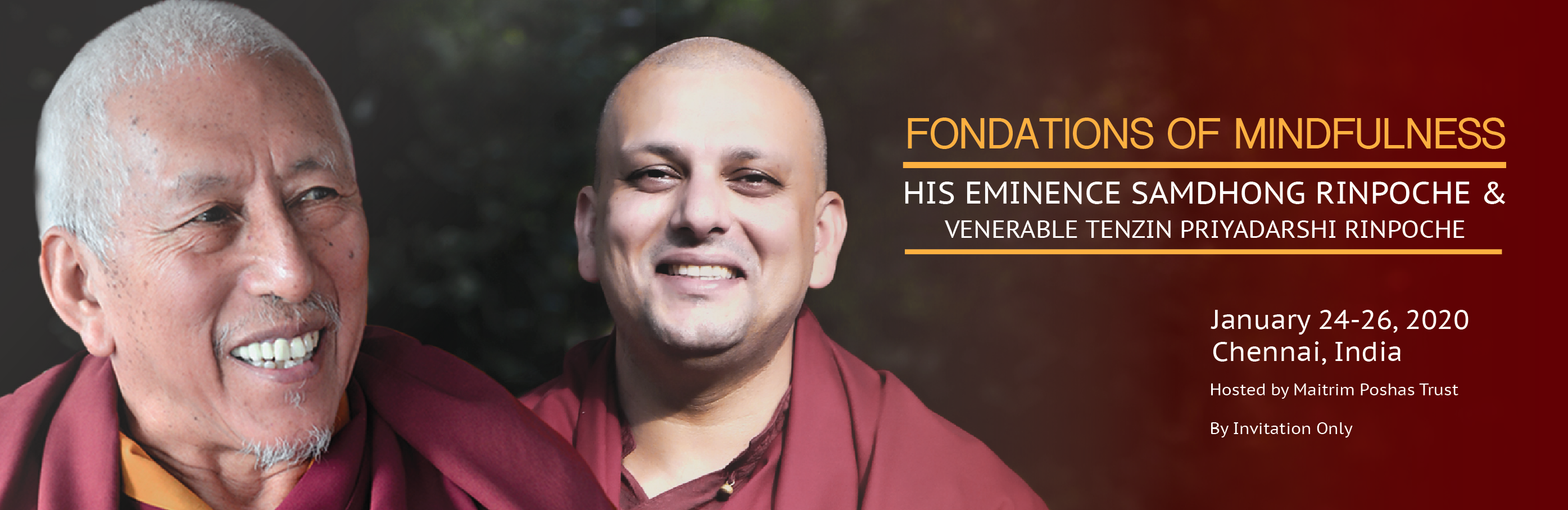
The Most Venerable Samdhong
Rinpoche
The Most Venerable Samdhong
Rinpoche is a Tibetan monk and renowned scholar. In 2001 he became
the first elected Kalon Tripa (Prime Minister) of the Tibetan Government-in-Exile,
through a new voting system of election initiative of HH the Dalai
Lama.
At the time elected, Samdhong Rinpoche had
left public service and had decided to set out on "a reclusive
life in order to begin my efforts for the cause of non-violence." After numerous requests from most of the exile Tibetan communities,
he relinquished his personal desires and accepted the responsibilities
of Prime Minister.
Rinpoche has said, "I believe we Tibetans
need to establish a non-violent society to serve as a model for
the rest of the world. In order to do this, we should first develop
a culture of ahimsa [non-violence] in our exile communities. We
can begin by designing projects for non-violent means of livelihood
in the exile communities. Tibetan settlements in India are ideal
places for undertaking this experiment. In short, I intend to promote
the Gandhian concept of gram swaraj [village self-rule] in our settlements.
Especially I intend to promote non-violent and eco-friendly agricultural
and farming practices in our settlements… Yes, there are people
who think that the only effective solution to any problem is through
violence. This is because non-violent movements are unable to attract
the attention of the world community. This is the biggest cause
for continued violence and disturbance. There is, therefore, the
need for solidarity and support to the principle of nonviolence
and actions that flow from it.”
Samdhong Lobsang Tenzin, the 5th Samdhong
Rinpoche, was born in 1939 in Eastern Tibet. At the age of five,
he was recognized as the reincarnation of 4th Samdhong Rinpoche.
In 1960, he started his service to the Tibetan
community as a teacher to monks of the Sera, Drepung, and Ganden
Monasteries. From 1961, he performed as the religious teacher of
the Tibetan School in Shimla and later became the acting Principal.
From 1965 to 1970 he was the Principal of the Dalhousie Tibetan
School. He received his Lharampa Degree in 1968 and Ngagrimpa Degree
in 1969. From 1971 he was Principal of the Central Institute of
Higher Tibetan Studies in Varanasi and from 1988 to 2001 he was
the Director. From 1996 to 2001 he was both Chairman and elected
member of the Parliament from Kham province.
Courtesy: http://www.tibet.com
Back
To Top
|