













New Solutions in Patient Care Management and Drug Delivery Methods

MIT Prajnopaya uBox/uPhone/uPrint Initiative:


uBox: A Low-Cost Device for Monitoring and Improving
Rural Tuberculosis Treatment Programs

IDEAS Team
Manish Bhardwaj
Goutam Reddy
Jayodita Sanghvi
Sara Cinnamon Singh
Bill Thies
Oliver Venn

D-Lab Team
Alex Krull
Jessica Leon
Nikhil Nadkarni
Oluwarotimi Okunade

Project Advisor: Ven. Tenzin Priyadarshi
Community Partner: The Prajnopaya Foundation

The Challenge
Every year, an estimated 8-10 million people contract tuberculosis (TB) and 1.7 million die from the disease, mostly in poor, rural communities in the developing world. This is despite the fact that TB can be completely cured in most cases via antibiotics, which governments usually provide free of cost to the needy. The central challenge continues to be drug adherence: ensuring that patients take the right drugs regularly for the entire course of 6-8 months.

Direct Observation Therapy (DOT), where a worker supervises ingestion of every dose, is a successful strategy to ensure adherence. However, it is costly and logistically challenging to run a labor intensive program in geographically dispersed rural communities with poor infrastructure. Thus, 2 out of 3 patients today do not have access to DOT.

Our Community Partner
The Prajnopaya Foundation runs DOT programs in Bihar, an Indian state with rampant poverty that is largely ignored by the government and other healthcare organizations. Prajnopaya's TB camps last year treated close to 600 patients with a 77% recovery rate.

Our Goals
Our goal is to provide reliable and timely patient and program status, which is indispensable to improving adherence, reducing costs and scaling DOT. Rural programs today have highly unreliable adherence record, and little information about DOT-worker activity.

A related goal is to enable communities to assume more adherence responsibility themselves, thereby enabling scaling (e.g. housewives paid to ensure neighborhood adherence). This is only feasible if patient and worker activity, and drug supplies can be reliably and efficiently tracked.

Feasibility
The proof-of-concept uBox [Upaya (Solutions) Box] prototype has been assembled. It has five mechanical parts and an electronics board.

The estimated cost for the basic version of the device is expected to be $7-8 in quantities of 1000 or more. The uBox is expected to last for 5 trials, thus costing under $2 per patient.

We have worked closely with the Prajnopaya foundation to ascertain the feasibility of the uBox in rural communities. Our first trial with 100 uBoxes will take place in Bihar starting Mar. 2008.

The uBox
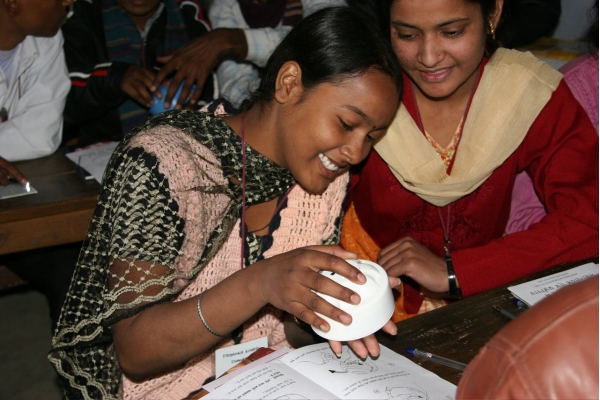
The uBox is a rugged, low-cost, easy to use smart pillbox. It is a palm-sized plastic container with 17 compartments, one for each dose (up to 4 pills). This allows roughly two months worth of drugs to be stored, after which it can be easily refilled.

The user rotates the top handle clockwise to expose a new compartment to an opening protected by a lid which can be lowered to remove pills.

The uBox includes a simple electronic timer that records the time when the lid is lowered to remove pills. This creates an adherence record.

DOT workers are given an audio plug and instructed to “touch” – insert it into, and remove it from – a port on top of the patient's uBox when visiting. The uBox records the time of this action, allowing DOT worker tracking.

uBox information can be read out by connecting a PDA, laptop or cell phone to the port. It also has a LED that reminds patients to take their pills.

Usage
Initially, DOT workers carry uBoxes to patients, demonstrate usage, and having dispensed the drug, bring the boxes back. This familiarizes the population with the device. After a couple of months, patients keep their uBoxes, but continue to be supervised. The uBoxes record worker visits in addition to adherence. In the final phase, workers may be instructed to visit highly adherent patients less frequently and focus on non-compliant or sicker patients.

Every 4-6 weeks, supervisors of DOT workers visit patients and collect data from uBoxes, which is used by organizers to intervene appropriately to improve adherence and efficiency.

Innovation
The uBox is the first device to enable DOT worker supervision by recording time of visits. It gathers adherence data at one-tenth the cost of the most popular pillbox today (Aardex MEMS). Unlike existing solutions, it is designed specifically for use in rural communities (no exposed compartments, long battery life, detects when opened for refilling etc.).

Impact
The uBox enables increased adherence, reduced costs and scalability in DOT programs.

Data driven intervention
Reliable adherence and worker data allows organizers to quickly focus on problematic areas (e.g., a region, gender, or, volunteer). Also, star performers can be easily identified and their strategies replicated elsewhere. This increases both adherence and program efficiency.

DOT worker supervision and incentives
DOT workers can be evaluated objectively and efficiently, and incentivized based on their patients' adherence and regularity of their visits.

Scalable adherence models
The uBox dispenses the correct combination of drugs, and keeps a record of adherence and worker activity. This enables incentivizing community members to participate in neighborhood adherence (e.g. the housewives example), and efficiently monitoring them.

Evaluating innovations
The uBox will enable systematic evaluation of program innovations.

Combating worker absenteeism
The uBox allows patients to take the correct dose if the DOT worker fails to show up.


Vision

uBox: The Global Standard for Treatment
Programs in Rural Communities
Collects vital information,
universally applicable, low in cost


uPrint – Ensuring Delivery with Fingerprint Authentication


About uPrint

Fingerprint identification establishes with a high degree of confidence that patients received their drugs from providers. While readers tend to be expensive, they are affordable in, e.g., urban settings where a single provider may serve, on the order of, a hundred patients a year.

How It Works

The solution consists of a fingerprint reader attached to a processing device, like a netbook or a cell phone, running custom software. Prints are recorded by impressing the finger on a reader. The system then searches a database of previously registered patient and personnel prints to identify and authenticate the user. Each provider is equipped with a unit, and patients and providers register their prints to establish the meeting.


Recording Health of TB Patients via a Cell Phone


The uPhone allows collecting detailed health information, while the uMessage is a basic version used to record dosage.

Health Recording (uPhone)

The uPhone is an ordinary cell phone with software that allows workers to record health indicators. Rural treatment programs today have poor knowledge of the evolving health of their patients, who are spread over a wide area. This leads to inefficient use of physicians, who are scarce to begin with in such settings. Physicians may spend hours getting to a village, when a different one had a more pressing need. Furthermore, the lack of medical history (especially treatment history in TB) affects outcomes. The uPhone was developed to mitigate these difficulties.

How It Works

The uPhone has a custom menu in the local language (and optionally English) that allows community workers with basic training to check off indicators related to TB. The uPhone may be used for both detecting new cases and periodically checking up on patients undergoing treatment. Programs can intervene, for instance, if side effects interfere with therapy, or if the patient continues to be symptomatic despite treatment.